This documentation covers integrating WalletConnect Pay through WalletKit. This approach provides a unified API where Pay is automatically configured when you configure WalletKit, simplifying the integration for wallet developers.

Sample Wallet

For a complete working example, check out our sample wallet implementation:

Sample Wallet - Swift (WalletKit)

A reference iOS wallet app demonstrating WalletConnect Pay via WalletKit.
Using AI for Integration? If you’re using an AI IDE or assistant to help with integration, you can provide it with our comprehensive AI integration prompt for better context and guidance.

Requirements

  • iOS 13.0+
  • Swift 5.7+
  • Xcode 14.0+
  • WalletKit (ReownWalletKit)
You also need a WCP ID for your project, obtained from the WalletConnect Dashboard. How to obtain a WCP ID
  1. Navigate to the WalletConnect Dashboard.
  2. Select the project that is associated with your wallet (as in, the projectId that is being used for your wallet’s WalletConnect integration).
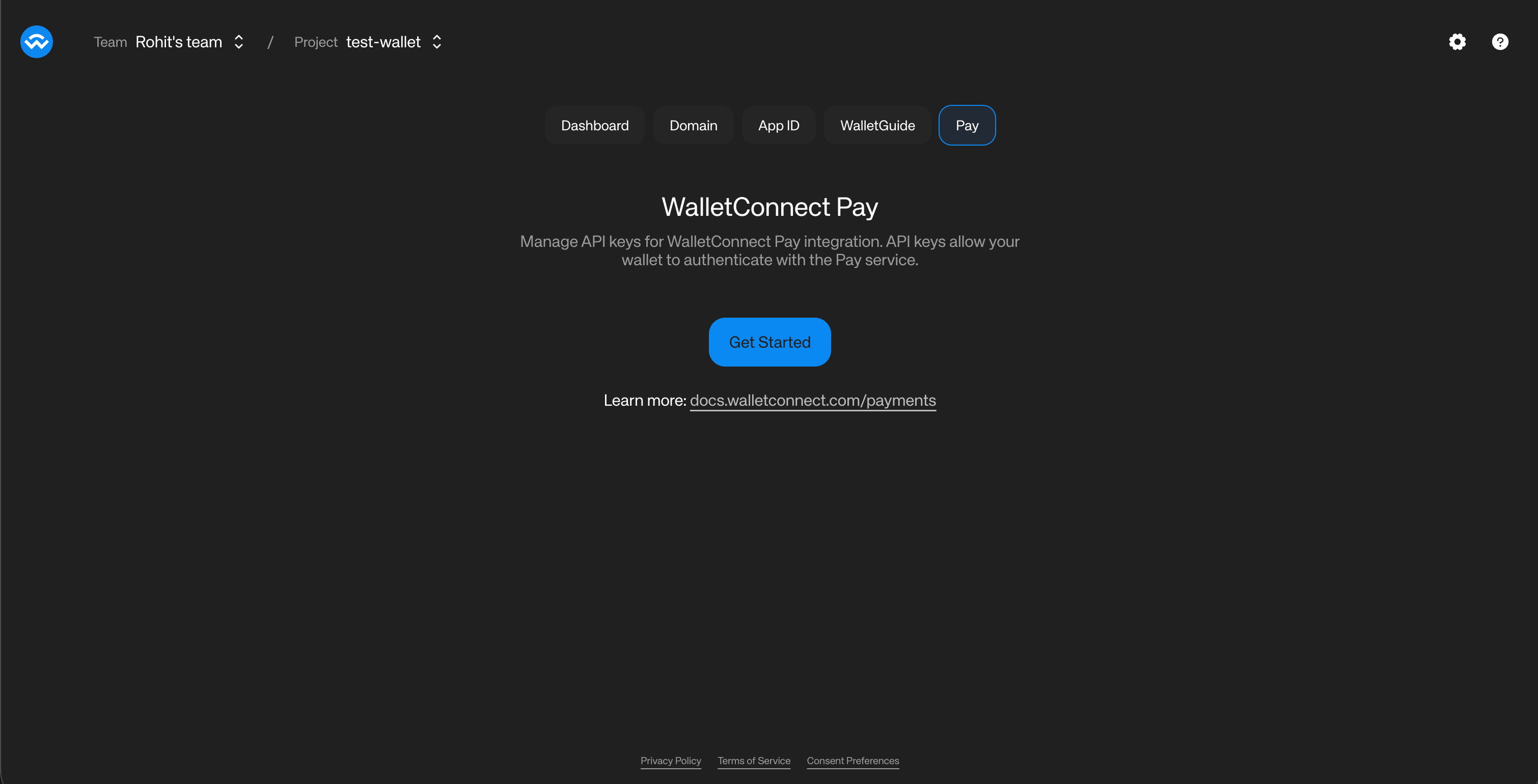
Select the project on WalletConnect Dashboard
  1. Click on the “Get Started” button to get a WCP ID associated with your project.
  2. The Dashboard will now show the WCP ID associated with your project.
  3. Click on the three dots on the right of the WCP ID and select “Copy WCP ID”. You will be using this for your wallet’s WalletConnect Pay integration.
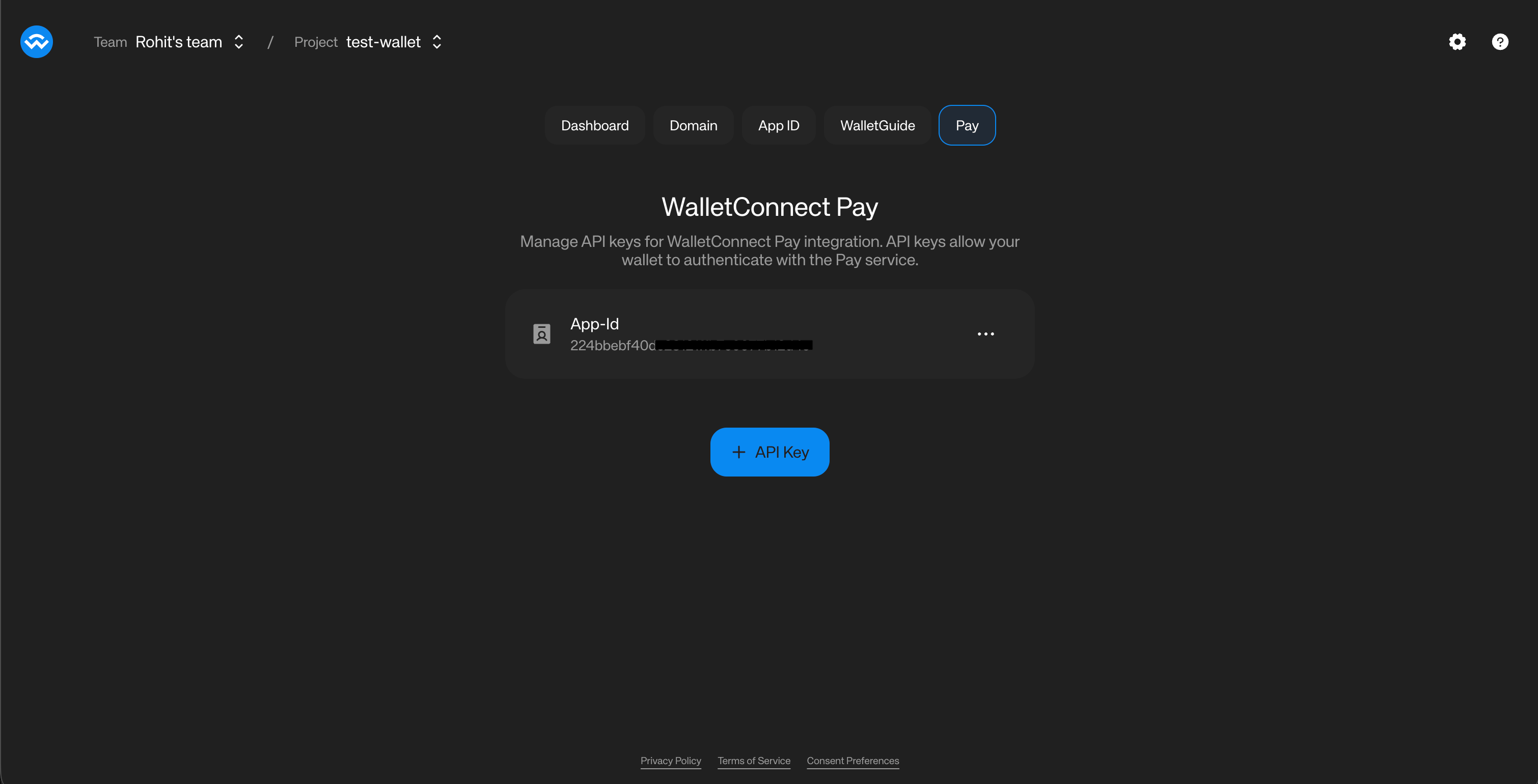
Copy WCP ID from WalletConnect Dashboard

Installation

Swift Package Manager Add ReownWalletKit to your Package.swift:
dependencies: [
    .package(url: "https://github.com/reown-com/reown-swift", from: "1.0.0")
]
Then add ReownWalletKit to your target dependencies:
.target(
    name: "YourApp",
    dependencies: ["ReownWalletKit"]
)
WalletConnectPay is automatically included as a dependency of WalletKit.
Check the GitHub releases for the latest version.

Initialization

When using WalletKit, Pay is automatically configured using your project’s Networking.projectId. No separate configuration is needed.
import ReownWalletKit

func application(_ application: UIApplication, didFinishLaunchingWithOptions...) {
    // Configure WalletKit - Pay is automatically configured
    WalletKit.configure(
        metadata: AppMetadata(
            name: "My Wallet",
            description: "A crypto wallet",
            url: "https://mywallet.com",
            icons: ["https://mywallet.com/icon.png"]
        ),
        crypto: DefaultCryptoProvider(),
        payLogging: true  // Enable Pay debug logging
    )
}
Use the static isPaymentLink method to detect payment links before processing:
// Static method - can be called before configure()
if WalletKit.isPaymentLink(scannedString) {
    startPaymentFlow(paymentLink: scannedString)
}

// Or via the instance
if WalletKit.instance.Pay.isPaymentLink(scannedString) {
    startPaymentFlow(paymentLink: scannedString)
}
The isPaymentLink utility method detects WalletConnect Pay links by checking for:
  • pay. hosts (e.g., pay.walletconnect.com)
  • pay= parameter in WalletConnect URIs
  • pay_ prefix in bare payment IDs
Call it wherever your wallet receives a link — from a deep link or a scanned QR code:
// Deep link opened from outside your app (SceneDelegate or AppDelegate)
func scene(_ scene: UIScene, openURLContexts URLContexts: Set<UIOpenURLContext>) {
    guard let url = URLContexts.first?.url else { return }
    if WalletKit.isPaymentLink(url.absoluteString) {
        startPaymentFlow(paymentLink: url.absoluteString)
    }
}

// QR code payload
func handleScannedQR(_ content: String) {
    if WalletKit.isPaymentLink(content) {
        startPaymentFlow(paymentLink: content)
    }
}

Payment Flow

The payment flow consists of six main steps: Detect Payment Link -> Get Options -> Collect Data (if required) -> Get Actions -> Sign Actions -> Confirm Payment
1

Get Payment Options

When a user scans a payment QR code or opens a payment link, fetch available payment options:
// 1. Get payment options
let options = try await WalletKit.instance.Pay.getPaymentOptions(
    paymentLink: paymentLink,
    accounts: ["eip155:1:\(address)", "eip155:137:\(address)"]
)

// Display merchant info
if let info = options.info {
    print("Merchant: \(info.merchant.name)")
    print("Amount: \(info.amount.display.assetSymbol) \(info.amount.value)")
}

// Show available payment options to user
for option in options.options {
    print("Pay with \(option.amount.display.assetSymbol) on \(option.amount.display.networkName ?? "Unknown")")
}

// Check which options require data collection
for option in options.options {
    if option.collectData != nil {
        print("Option \(option.id) requires info capture")
    }
}
2

Collect User Data (If Required)

After the user selects an option, check for collectData on it. If present, collect the data before fetching the required actions.

Embedded Data Collection Form

When a payment requires user information (e.g., for Travel Rule compliance), the SDK returns a collectData field on individual payment options. Each option may independently require data collection — some options may require it while others don’t.The form is loaded from selectedOption.collectData.url and embedded in your wallet (a WebView on mobile, an iframe on web). It handles field rendering, validation, Terms & Conditions and Privacy Policy acceptance, and submits data directly to the backend.Collect this data before fetching the required actions. For an option that requires Information Capture, getRequiredPaymentActions fails with 400 IC data required until the data has been submitted.The recommended approach is to display all payment options upfront, then handle data collection only when the user selects an option that requires it:
  1. Call getPaymentOptions and display all available options to the user
  2. Show a visual indicator (e.g., “Info required” badge) on options where option.collectData is present
  3. When the user selects an option, check selectedOption.collectData
  4. If present, load selectedOption.collectData.url in the embedded form
  5. Optionally append query parameters to the form URL — prefill (known user data), theme, and themeVariables (appearance). See Form URL parameters below. Use proper URL building so existing query parameters are preserved.
  6. Listen for completion messages: IC_COMPLETE (success) or IC_ERROR (failure)
  7. On IC_COMPLETE, continue the flow — fetch the required actions, sign, and confirm the payment. Don’t pass collectedData to confirmPayment(); the form submits data directly to the backend

Decision Matrix

Response collectDataoption.collectDataBehavior
presentpresentOption requires IC — use option.collectData.url
presentnullOption does NOT require IC (others might) — skip IC for this option
nullnullNo IC needed for any option

Form URL parameters

The form URL accepts the following optional query parameters. Append them to selectedOption.collectData.url before loading it, preserving any existing query parameters.
ParameterFormatDescription
prefillbase64url-encoded JSONPre-populates known user fields so the user doesn’t re-enter them. Keys must match the required fields from collectData.schema (e.g. fullName, dob, pobAddress).
themelight or darkSets the form’s base color mode.
themeVariablesbase64url-encoded JSONOverrides design tokens to match your brand — font, font size, select colors, button border radius, and input border radius. Generate and export this value from the WalletConnect Pay Dashboard.
collectData.schema is a JSON schema string — parse it and read its required array to discover the field keys for prefill. For example, a required array of ["fullName", "dob", "pobAddress"] maps to a prefill object of {"fullName": "...", "dob": "...", "pobAddress": "..."}.

Customizing the form appearance

theme and themeVariables are optional and independent — pass either, both, or neither:
  • theme switches the form between light and dark base color modes. Match it to your wallet’s active mode for a seamless transition.
  • themeVariables applies brand-level overrides (font, font size, select colors, button border radius, and input border radius). Generate the theme in the WalletConnect Pay Dashboard, export it as a base64url string, and append it to the form URL verbatim — you don’t need to encode it at runtime.
The top-level collectData on the payment options response is still available for backward compatibility. However, the per-option collectData is the recommended approach as it provides more granular control over the flow.
Do not pass collectedData to confirmPayment() when using the embedded form. The form handles data submission directly.
// Check per-option data collection requirement after user selects an option
if let collectData = selectedOption.collectData, let url = collectData.url {
    // Use the "required" list from collectData.schema to determine which fields to prefill
    let prefillData: [String: String] = [
        "fullName": "John Doe",
        "dob": "1990-01-15",
        "pobAddress": "123 Main St, New York, NY 10001"
    ]
    let jsonData = try JSONSerialization.data(withJSONObject: prefillData)
    // Encode prefill as base64url (URL-safe, no padding)
    let prefillBase64 = jsonData.base64EncodedString()
        .replacingOccurrences(of: "+", with: "-")
        .replacingOccurrences(of: "/", with: "_")
        .replacingOccurrences(of: "=", with: "")
    var components = URLComponents(string: url)!
    var queryItems = components.queryItems ?? []
    queryItems.append(URLQueryItem(name: "prefill", value: prefillBase64))
    // Optional appearance params (see "Form URL parameters"):
    queryItems.append(URLQueryItem(name: "theme", value: "dark")) // "light" | "dark"
    // themeVariables is a base64url string exported from the WalletConnect Pay Dashboard:
    // queryItems.append(URLQueryItem(name: "themeVariables", value: themeVariables))
    components.queryItems = queryItems
    let webViewUrl = components.string!

    // Show WebView for this specific option and wait for IC_COMPLETE message
    showWebView(url: webViewUrl)
}

WebView Message Types

The WebView communicates with your wallet through JavaScript bridge messages. The message payload is a JSON string with the following structure:
Message TypePayloadDescription
IC_COMPLETE{ "type": "IC_COMPLETE", "success": true }User completed the form successfully. Proceed to payment confirmation.
IC_ERROR{ "type": "IC_ERROR", "error": "..." }An error occurred. Display the error message and allow the user to retry.
Platform-Specific Bridge Names
PlatformBridge NameHandler
Kotlin (Android)AndroidWallet@JavascriptInterface onDataCollectionComplete(json: String)
Swift (iOS)payDataCollectionCompleteWKScriptMessageHandler.didReceive(message:)
FlutterReactNativeWebView (injected via JS bridge)JavaScriptChannel.onMessageReceived
React NativeReactNativeWebView (native)WebView.onMessage prop
3

Get Required Actions

After the user selects a payment option, get the signing actions:
// 2. Get required actions for selected option
let actions = try await WalletKit.instance.Pay.getRequiredPaymentActions(
    paymentId: options.paymentId,
    optionId: selectedOption.id
)
4

Sign Actions

Each action contains a walletRpc describing the RPC call to execute. Your wallet must check the method field and dispatch accordingly — for example, a payment option may require an eth_sendTransaction to approve a token allowance followed by an eth_signTypedData_v4 to sign Permit2 typed data:
// 3. Sign each action based on its RPC method
var signatures: [String] = []
for action in actions {
    let rpc = action.walletRpc

    let result: String
    switch rpc.method {
    case "eth_signTypedData_v4":
        result = try await signTypedData(rpc)
    case "eth_sendTransaction":
        result = try await sendTransaction(rpc)
    case "personal_sign":
        result = try await personalSign(rpc)
    default:
        throw PaymentError.unsupportedMethod(rpc.method)
    }
    signatures.append(result)
}
Payment options may include multiple actions with different RPC methods. For example, a Permit2 payment where the user lacks sufficient allowance returns two actions: an eth_sendTransaction to approve the token allowance, followed by an eth_signTypedData_v4 to sign the Permit2 transfer. Your wallet must check action.walletRpc.method and dispatch to the appropriate handler. For full implementation guidance, see USDT support.

Signing Implementation

private func signAction(
    action: Action,
    walletAddress: String,
    signer: YourSignerProtocol
) async throws -> String {
    let rpc = action.walletRpc

    switch rpc.method {
    case "eth_signTypedData_v4":
        guard let paramsData = rpc.params.data(using: .utf8),
              let params = try JSONSerialization.jsonObject(with: paramsData) as? [Any],
              params.count >= 2,
              let typedDataJson = params[1] as? String else {
            throw PaymentError.invalidParams
        }
        return try await signer.signTypedData(
            data: typedDataJson,
            address: walletAddress
        )
    case "eth_sendTransaction":
        return try await signer.sendTransaction(
            params: rpc.params,
            chainId: rpc.chainId
        )
    case "personal_sign":
        return try await signer.personalSign(
            params: rpc.params,
            address: walletAddress
        )
    default:
        throw PaymentError.unsupportedMethod(rpc.method)
    }
}
Signatures must be in the same order as the actions array.
5

Confirm Payment

Submit the signatures to complete the payment:
When using the WebView approach for data collection, the WebView submits the captured data directly to the backend, so you do not pass collectedData to confirmPayment.
// 4. Confirm payment
let result = try await WalletKit.instance.Pay.confirmPayment(
    paymentId: options.paymentId,
    optionId: selectedOption.id,
    signatures: signatures
)

switch result.status {
case .succeeded:
    print("Payment successful!")
case .processing:
    print("Payment is being processed...")
case .failed:
    print("Payment failed")
case .expired:
    print("Payment expired")
case .requiresAction:
    print("Additional action required")
case .cancelled:
    print("Payment cancelled")
}

Data Collection Implementation

When selectedOption.collectData.url is present, display the URL in a WKWebView. The WebView handles form rendering, validation, and T&C acceptance. Data Collection Best Practices
  • Display prominently: Show the form full-screen or as a prominent modal so users can interact with it easily
  • Loading indicator: Show a loading indicator while the form loads
  • Handle errors: Listen for IC_ERROR messages and display a user-facing error message with an option to retry
  • External links: Open Terms & Conditions and Privacy Policy links in the system browser rather than navigating within the form
  • Domain restriction: Only allow navigation to WalletConnect pay domains and HTTPS URLs
  • Back navigation: Handle back/dismiss gracefully — confirm cancellation with the user before closing the form mid-flow
  • Keyboard behavior: Test that the soft keyboard appears and behaves correctly when users tap on form inputs
  • Theme to match your brand: Pass theme=light or theme=dark to match your wallet’s active color mode, and apply brand tokens with themeVariables exported from the WalletConnect Pay Dashboard. See Form URL parameters.
import WebKit
import SwiftUI

struct PayDataCollectionWebView: UIViewRepresentable {
    let url: URL
    let onComplete: () -> Void
    let onError: (String) -> Void

    func makeCoordinator() -> Coordinator {
        Coordinator(onComplete: onComplete, onError: onError)
    }

    func makeUIView(context: Context) -> WKWebView {
        let config = WKWebViewConfiguration()
        config.userContentController.add(
            context.coordinator,
            name: "payDataCollectionComplete"
        )

        let webView = WKWebView(frame: .zero, configuration: config)
        webView.navigationDelegate = context.coordinator
        webView.load(URLRequest(url: url))
        return webView
    }

    func updateUIView(_ uiView: WKWebView, context: Context) {}

    class Coordinator: NSObject, WKScriptMessageHandler, WKNavigationDelegate {
        let onComplete: () -> Void
        let onError: (String) -> Void

        init(onComplete: @escaping () -> Void, onError: @escaping (String) -> Void) {
            self.onComplete = onComplete
            self.onError = onError
        }

        func userContentController(
            _ userContentController: WKUserContentController,
            didReceive message: WKScriptMessage
        ) {
            guard let body = message.body as? String,
                  let data = body.data(using: .utf8),
                  let json = try? JSONSerialization.jsonObject(with: data) as? [String: Any],
                  let type = json["type"] as? String else { return }

            DispatchQueue.main.async {
                switch type {
                case "IC_COMPLETE":
                    self.onComplete()
                case "IC_ERROR":
                    let error = json["error"] as? String ?? "Unknown error"
                    self.onError(error)
                default:
                    break
                }
            }
        }

        func webView(
            _ webView: WKWebView,
            decidePolicyFor navigationAction: WKNavigationAction,
            decisionHandler: @escaping (WKNavigationActionPolicy) -> Void
        ) {
            guard let url = navigationAction.request.url else {
                decisionHandler(.allow)
                return
            }
            if let host = url.host, !host.contains("pay.walletconnect.com") {
                UIApplication.shared.open(url)
                decisionHandler(.cancel)
                return
            }
            decisionHandler(.allow)
        }
    }
}

Complete Example

Here’s a complete implementation using WalletKit:
import ReownWalletKit

class PaymentManager {
    
    func processPayment(
        paymentLink: String,
        walletAddress: String,
        signer: YourSignerProtocol
    ) async throws {
        
        // 1. Get payment options
        let accounts = [
            "eip155:1:\(walletAddress)",
            "eip155:137:\(walletAddress)",
            "eip155:8453:\(walletAddress)"
        ]
        
        let optionsResponse = try await WalletKit.instance.Pay.getPaymentOptions(
            paymentLink: paymentLink,
            accounts: accounts
        )
        
        guard !optionsResponse.options.isEmpty else {
            throw PaymentError.noOptionsAvailable
        }
        
        // 2. Let user select an option (simplified - use first option)
        let selectedOption = optionsResponse.options[0]

        // 3. Collect data via WebView if required (before fetching actions)
        if let collectData = selectedOption.collectData, let url = collectData.url {
            try await showDataCollectionWebView(url: url)
        }

        // 4. Get required actions
        let actions = try await WalletKit.instance.Pay.getRequiredPaymentActions(
            paymentId: optionsResponse.paymentId,
            optionId: selectedOption.id
        )
        
        // 5. Sign all actions
        var signatures: [String] = []
        for action in actions {
            let signature = try await signAction(
                action: action,
                walletAddress: walletAddress,
                signer: signer
            )
            signatures.append(signature)
        }

        // 6. Confirm payment
        let result = try await WalletKit.instance.Pay.confirmPayment(
            paymentId: optionsResponse.paymentId,
            optionId: selectedOption.id,
            signatures: signatures
        )
        
        switch result.status {
        case .succeeded:
            break // Success
        case .cancelled:
            throw PaymentError.paymentCancelled
        default:
            throw PaymentError.paymentFailed(result.status)
        }
    }

    private func signAction(
        action: Action,
        walletAddress: String,
        signer: YourSignerProtocol
    ) async throws -> String {
        let rpc = action.walletRpc

        switch rpc.method {
        case "eth_signTypedData_v4":
            guard let paramsData = rpc.params.data(using: .utf8),
                  let params = try JSONSerialization.jsonObject(with: paramsData) as? [Any],
                  params.count >= 2,
                  let typedDataJson = params[1] as? String else {
                throw PaymentError.invalidParams
            }
            return try await signer.signTypedData(
                data: typedDataJson,
                address: walletAddress
            )
        case "eth_sendTransaction":
            return try await signer.sendTransaction(
                params: rpc.params,
                chainId: rpc.chainId
            )
        case "personal_sign":
            return try await signer.personalSign(
                params: rpc.params,
                address: walletAddress
            )
        default:
            throw PaymentError.unsupportedMethod(rpc.method)
        }
    }
}

API Reference

WalletKit Integration When using WalletKit, Pay methods are accessed via WalletKit.instance.Pay.*. Static Methods
MethodDescription
WalletKit.isPaymentLink(_:)Check if a string is a payment link (can call before configure())
Instance Methods (WalletKit.instance.Pay)
MethodDescription
isPaymentLink(_:)Check if a string is a payment link
getPaymentOptions(paymentLink:accounts:includePaymentInfo:)Fetch available payment options
getRequiredPaymentActions(paymentId:optionId:)Get signing actions for a payment option
confirmPayment(paymentId:optionId:signatures:maxPollMs:)Confirm and execute the payment
Data Types PaymentOptionsResponse
struct PaymentOptionsResponse {
    let paymentId: String              // Unique payment identifier
    let info: PaymentInfo?             // Merchant and amount details
    let options: [PaymentOption]       // Available payment methods
    let collectData: CollectDataAction? // Required user data fields (travel rule)
    let resultInfo: PaymentResultInfo? // Transaction result details (present when payment already completed)
}

struct PaymentResultInfo {
    let txId: String                   // Transaction ID
    let optionAmount: PayAmount        // Token amount details
}
PaymentInfo
struct PaymentInfo {
    let status: PaymentStatus          // Current payment status
    let amount: PayAmount              // Requested payment amount
    let expiresAt: Int64               // Expiration timestamp
    let merchant: MerchantInfo         // Merchant details
    let buyer: BuyerInfo?              // Buyer info if available
}
PaymentOption
struct PaymentOption {
    let id: String                     // Option identifier
    let amount: PayAmount              // Amount in this asset
    let etaS: Int64                    // Estimated time to complete (seconds)
    let actions: [Action]              // Required signing actions
    let collectData: CollectDataAction? // Per-option data collection (nil if not required)
}
PayAmount
struct PayAmount {
    let unit: String                   // Asset unit (e.g., "USDC")
    let value: String                  // Raw value in smallest unit
    let display: AmountDisplay         // Human-readable display info
}

struct AmountDisplay {
    let assetSymbol: String            // Token symbol (e.g., "USDC")
    let assetName: String              // Token name (e.g., "USD Coin")
    let decimals: Int64                // Token decimals
    let iconUrl: String?               // Token icon URL
    let networkName: String?           // Network name (e.g., "Base")
}
Action & WalletRpcAction
struct Action {
    let walletRpc: WalletRpcAction     // RPC call to sign
}

struct WalletRpcAction {
    let chainId: String                // Chain ID (e.g., "eip155:8453")
    let method: String                 // RPC method (e.g., "eth_signTypedData_v4", "eth_sendTransaction")
    let params: String                 // JSON-encoded parameters
}
CollectDataAction
struct CollectDataAction {
    let url: String                    // WebView URL for data collection
    let schema: String?                // JSON schema describing required fields
}
ConfirmPaymentResultResponse
struct ConfirmPaymentResultResponse {
    let status: PaymentStatus          // Final payment status
    let isFinal: Bool                  // Whether status is final
    let pollInMs: Int64?               // Suggested poll interval
    let info: PaymentResultInfo?       // Transaction result details (present on success)
}
PaymentStatus
enum PaymentStatus {
    case requiresAction                // Additional action needed
    case processing                    // Payment in progress
    case succeeded                     // Payment completed
    case failed                        // Payment failed
    case expired                       // Payment expired
    case cancelled                     // Payment cancelled by user
}

Error Handling

The SDK throws specific error types for different failure scenarios: GetPaymentOptionsError
ErrorDescription
.paymentNotFoundPayment ID doesn’t exist
.paymentExpiredPayment has expired
.invalidRequestInvalid request parameters
.invalidAccountInvalid account format
.complianceFailedCompliance check failed
.httpNetwork error
.internalErrorServer error
GetPaymentRequestError
ErrorDescription
.optionNotFoundSelected option doesn’t exist
.paymentNotFoundPayment ID doesn’t exist
.invalidAccountInvalid account format
.httpNetwork error
ConfirmPaymentError
ErrorDescription
.paymentNotFoundPayment ID doesn’t exist
.paymentExpiredPayment has expired
.invalidOptionInvalid option ID
.invalidSignatureSignature verification failed
.routeExpiredPayment route expired
.httpNetwork error

Best Practices

  1. Use WalletKit Integration: If your wallet already uses WalletKit, prefer the WalletKit.instance.Pay.* access pattern for automatic configuration
  2. Use isPaymentLink() for Detection: Use the utility method instead of manual URL parsing for reliable payment link detection
  3. Account Format: Always use CAIP-10 format for accounts: eip155:{chainId}:{address}
  4. Multiple Chains: Provide accounts for all supported chains to maximize payment options
  5. Signature Order: Maintain the same order of signatures as the actions array
  6. Error Handling: Always handle errors gracefully and show appropriate user feedback
  7. Loading States: Show loading indicators during API calls and signing operations
  8. Expiration: Check paymentInfo.expiresAt and warn users if time is running low
  9. User Data: Only collect data when collectData is present on the selected payment option and you don’t already have the required user data. If you already have the required data, you can submit this without collecting from the user. You must make sure the user accepts WalletConnect Terms and Conditions and Privacy Policy before submitting user information to WalletConnect.
  10. WebView Data Collection: When selectedOption.collectData?.url is present, display the URL in a WKWebView rather than building native forms. The WebView handles form rendering, validation, and T&C acceptance.
  11. Per-Option Data Collection: When displaying payment options, check each option’s collectData field. Show a visual indicator (e.g., “Info required” badge) on options that require data collection. Only open the WebView when the user selects an option with collectData present — use the option’s collectData.url which is already scoped to that option’s account.